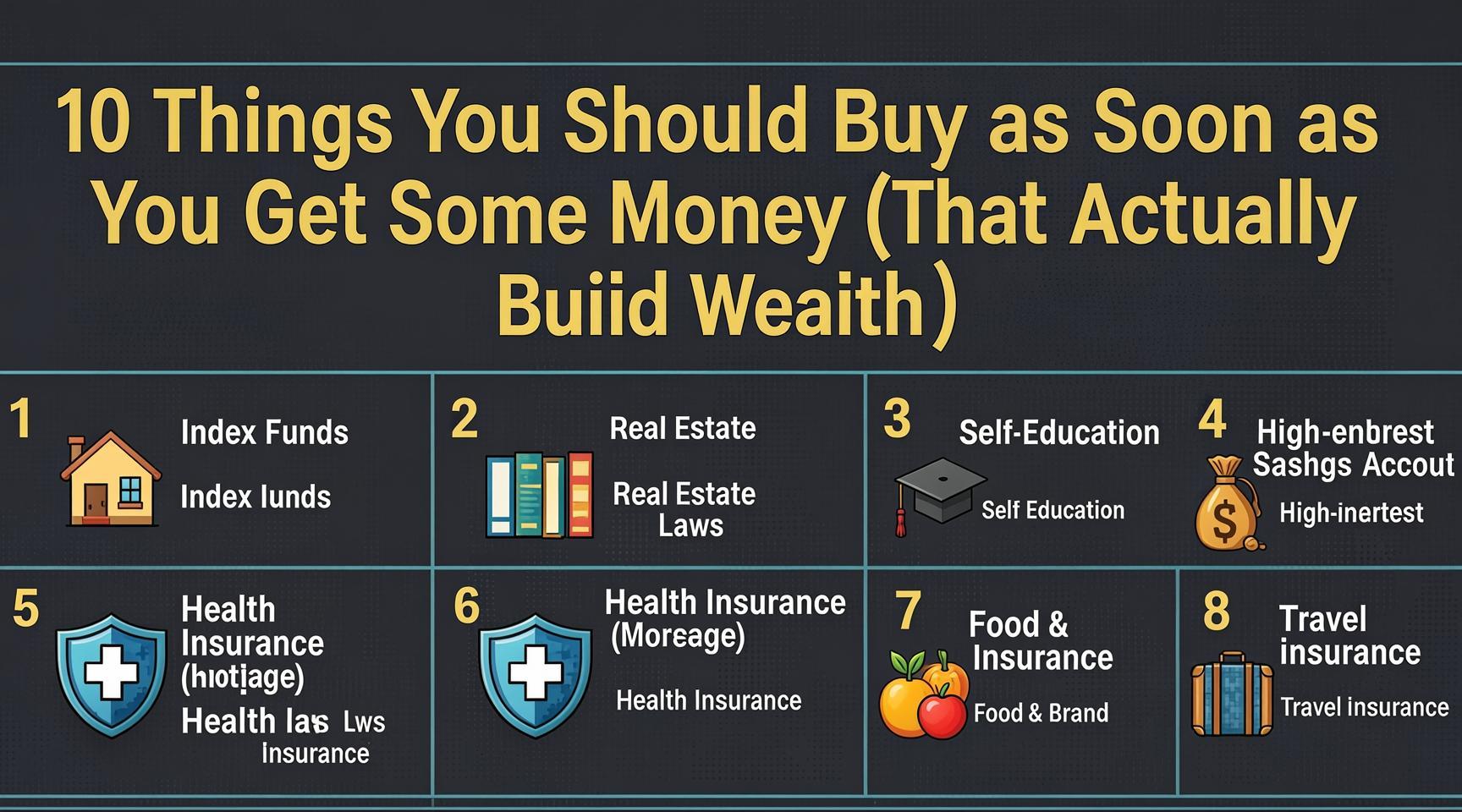
10 Things You Should Buy as Soon as You Get Some Money

Most financial advice focuses on what not to buy. This is the opposite. Once you've built a solid foundation—an emergency fund, an index fund portfolio, a stable financial base—and you have spare money you can afford to risk or deploy strategically, certain purchases stop being expenses and become investments that compound. Here are ten things worth buying that genuinely upgrade your life, your earning potential, and your long-term wealth.
1. Alternative Assets You Can Enjoy
Classic cars, certain watches, fine wine, and art all have the potential to hold or increase in value over time. Unlike numbers moving on a screen, these are real assets you get to live with and enjoy. A Ford Fiesta XR2 bought years ago for £1,750 would now represent a 1,000% return. These aren't guaranteed investments—they carry risk like any other—but they offer something index funds never will: the daily experience of owning something you genuinely appreciate. The key is buying assets with established collector markets and holding them long enough for scarcity to drive value.
2. Outsource Tasks That Cost Less Than Your Time
The average person spends 234 hours every year cleaning their house—roughly 29 full days. Cooking, gardening, driving, and dog walking add more. The question isn't whether hiring help costs money; it's whether it costs less than your time is worth.
Calculate your effective hourly rate: divide your annual earnings by the hours you actually work. If you earn $80,000 and work 2,000 hours annually, your rate is $40 per hour. The moment you can pay someone less than that rate to take a task off your hands, you should seriously consider it. Every hour freed goes toward higher-value work—your business, your side hustle, or strategic thinking that generates far more than the cost of the help.
3. Books That Condense Decades Into Days
For the price of two cups of coffee, you can absorb decades of someone's life summarized in a couple hundred pages. The right book at the right time changes your trajectory. Four recommendations based on where you are in your journey:
The Millionaire Fastlane by MJ DeMarco exposes traditional financial advice as a trap and provides a framework for building wealth through entrepreneurship rather than slow, conventional saving.
The E-Myth Revisited by Michael Gerber shows why most small businesses fail and how to build one that runs without you—so you own a business, not just another job.
The Little Book of Common Sense Investing by John Bogle reveals the simple, hands-off approach to growing money that quietly beats most professional fund managers.
How to Win Friends and Influence People by Dale Carnegie teaches the relational skills that open nearly any door. In the end, everything comes down to your relationships.
4. The Right Partner
This isn't relationship advice disguised as financial advice—it's a statistical reality. The partner you choose is one of the single biggest factors in how wealthy you'll become. Married people end up with approximately 77% more wealth per person than those who stay single, and their net worth climbs by roughly 16% for every year they stay married. The right partner supports your goals, contributes to your business, and amplifies your efforts. The wrong partner does the opposite. Choose wisely, because the stakes are measured in decades and dollars.
5. Mentors and High-Income Skills
The people you learn from set the ceiling on everything you'll achieve. Researchers tracked nearly a thousand children for decades and found that those with mentors went on to earn substantially more than those without. Today, finding mentors is easier than ever—some of the best minds in the world speak at events, appear on podcasts, and make videos completely free.
The best advice from a mentor: learn a high-income skill. Digital skills like video editing, copywriting, brand design, website funnel building, and AI automation now command premium rates. If you use AI to build high-converting websites that help businesses generate an extra $20,000 per month, they'll happily pay you $2,000 to $3,000 monthly for that result. The skill becomes your money-making machine.
6. Upgraded Tools for Your Money-Making Machine
A side hustle or business is like a machine that prints money. At first, you're satisfied with what it produces. Eventually, you wonder if it can print more. Upgrading your tools—a better camera, a new microphone, a faster laptop, AI software that increases efficiency—isn't a cost. It's an investment into that machine. When a videographer upgrades from an entry-level camera to professional equipment, clients notice the difference immediately. The investment pays for itself and then some. These expenses are also tax-deductible, effectively reducing their net cost.
7. A High-Level Accountant and Financial Software
When you start making real money, you need an accountant accustomed to working with clients far ahead of your current position—people who have faced challenges you haven't considered yet. A good accountant saves you multiples of their fee through tax optimization alone.
To reduce your bill, use software that manages your own finances. Odoo offers a completely free accounting application that connects to your bank account, automatically matches payments and transactions, generates balance sheets and profit and loss statements, and lets you compare periods to keep your finger on the pulse of your finances. The less time your accountant spends organizing your records, the less they charge, and the more strategic their advice can be.
8. A Chair That Doesn't Destroy Your Back
Due to modern work, most people spend the majority of their waking hours sitting. A comfortable, ergonomic chair isn't a luxury purchase—it's an investment in your ability to work long-term. When your back gives out, you're done. The cost of a quality chair is trivial compared to the lost productivity, medical bills, and misery of chronic back pain. Buy the best one you can afford before you need it.
9. Quality Sleep
Sleep deprivation reduces decision-making ability to the same extent as being legally drunk. Operating in that state for months or years isn't dedication—it's self-sabotage. A fitness wearable that tracks sleep, recovery, and daily strain provides objective data on whether you're actually rested enough to perform. The data changes behavior in ways that willpower alone never will. Hard work is important, but listening to your body and getting enough rest is equally crucial. A few late nights are part of the process; chronic sleep deprivation is not.
10. Experiences Over Things
Every purchase goes through three emotional phases: anticipation, the moment itself, and the aftertaste. Physical products—a new phone, designer clothes—produce medium anticipation (waiting is frustrating), high momentary satisfaction, and low aftertaste. The buzz fades within weeks. The object sits there, aging and going out of date.
Experiences—a dream vacation, concert tickets with friends—produce high anticipation (the waiting is part of the fun), high satisfaction in the moment, and high aftertaste. The memory lasts a lifetime. Products get outdated; experiences get retold.
The things purchased years ago are long forgotten. The memories—flying an airplane solo for the first time, being trackside at Monaco, meeting heroes—shape who you become, give you a fuller life, and leave stories you can tell forever. Buy the experiences. The objects won't matter when you look back.