
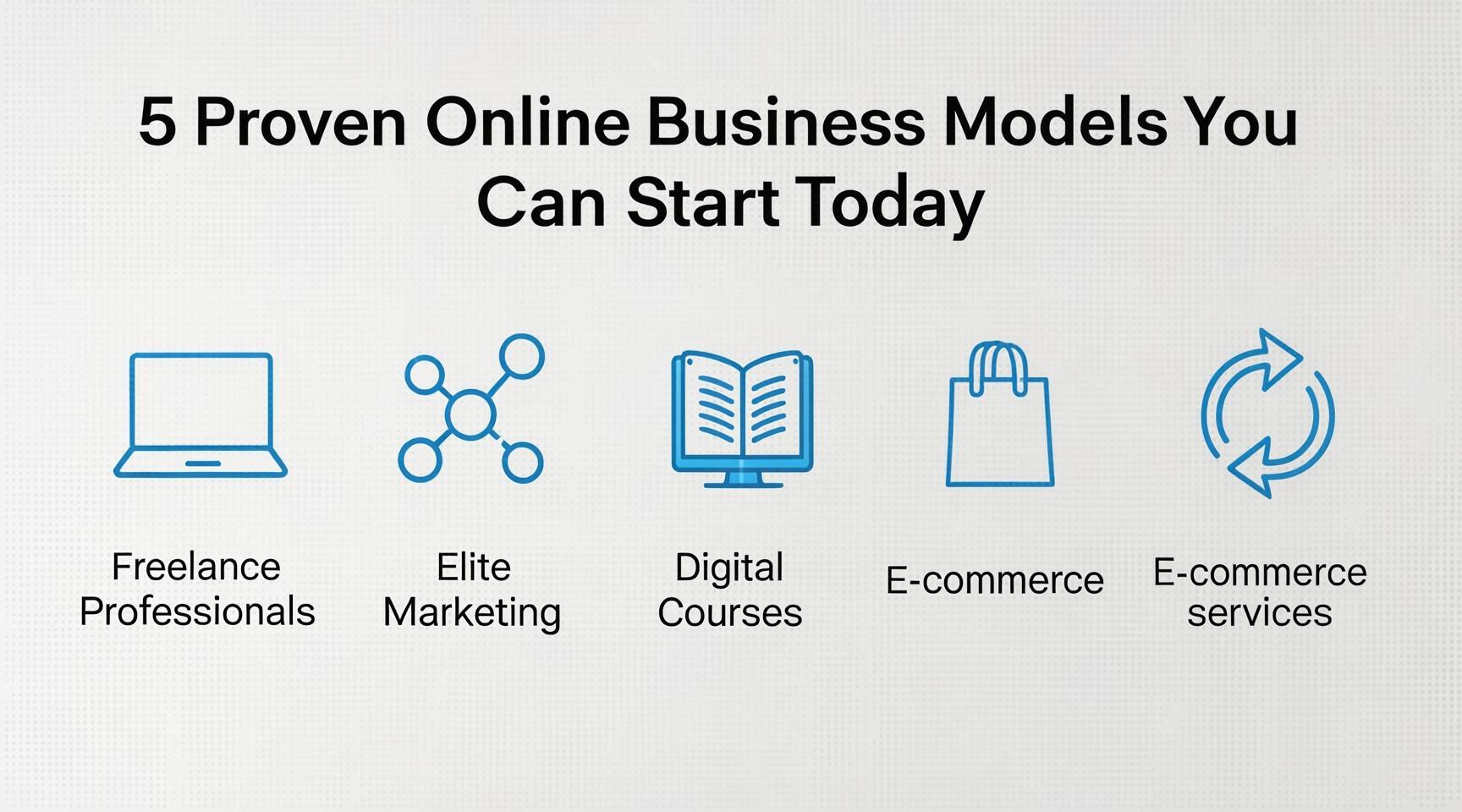
5 Proven Online Business Models You Can Start Today

The internet has democratized entrepreneurship. You no longer need a warehouse full of inventory, a film crew, or a teaching degree to build a profitable business. What you need is a clear model, the right tools, and a willingness to execute. Here, we break down five distinct, proven business models—each with the potential to generate passive income once established. Whether you’re a complete beginner or looking to add a new income stream, these step-by-step breakdowns give you everything you need to get started.
1. Digital Products: Create Once, Sell Forever
A digital product is any intangible asset you create once and sell repeatedly—no inventory, no shipping, no manufacturing. It’s one of the purest forms of passive income.
What you can sell:
Ebooks and guides
Canva templates
Notion templates
Excel spreadsheets and Google Sheets
Resume and CV templates
Social media calendars and content planners
Fitness and meal plans
Lightroom presets
AI prompt packs
Where to sell: Gumroad, Etsy, Payhip, Stan Store, Ko-fi, Creative Market, and Shopify.
How to find a winning idea: Start with one painful problem your audience wants solved—saving time, making money, getting organized, improving health, or enhancing content. Validate demand using Etsy search, Google Trends, TikTok search, Pinterest Trends, and Amazon Kindle categories. Low-ticket products typically sell for $5–$29; bundles or comprehensive kits can go for $49–$99.
Creation and delivery: Design your product using free or low-cost tools like Canva, Google Docs, Notion, Figma, Excel, or Adobe Express. Your main effort goes into making something genuinely useful, writing a compelling sales page, adding eye-catching mockups, and promoting it with short videos or Pinterest pins. Delivery is automatic after payment—customers download the file instantly.
2. YouTube Automation: Build a Faceless Cash-Flow Channel
YouTube automation is the business of running a channel without ever showing your face. You outsource scriptwriting, voice-overs, editing, and thumbnail creation, focusing only on strategy and topic selection.
Top-performing niches: Finance, business, AI tools, history, luxury, sports, health, education, documentaries, tech reviews, and celebrity news. Avoid copying content verbatim; YouTube penalizes unoriginal material harshly.
Essential tools: Use YouTube Studio for analytics, VidIQ or TubeBuddy for keyword research, Canva or Photoshop for thumbnails, and CapCut, Premiere Pro, DaVinci Resolve, or Final Cut Pro for editing. Hire freelancers on Fiverr, Upwork, onlinejobs.ph, or Contra. Typical costs: $10–$40 per script, $10–$50 for voice-over, $30–$150 for editing, and $5–$30 per thumbnail.
Monetization: YouTube’s Partner Program requires 1,000 subscribers and 4,000 public watch hours (or 10 million Shorts views). Beyond ads, leverage sponsorships, affiliate links, and your own digital products. Success hinges on audience retention, strong titles, clickable thumbnails, and a consistent upload schedule.
3. Print on Demand: Sell Custom Merch Without Inventory
Print on demand lets you sell physical products—t-shirts, hoodies, mugs, tote bags, posters, phone cases, stickers, hats—without ever holding stock. When a customer places an order, the supplier prints and ships directly to them.
Platforms: Printful, Printify, Gelato, Teespring (now Spring), Redbubble, Zazzle, and Merch by Amazon. Sell through Etsy, Shopify, Amazon, eBay, or your own website.
Winning strategy: Avoid generic designs. Instead, target specific, passionate audiences: nurses, teachers, gym lovers, dog owners, gamers, truck drivers, moms, students, or hobby communities. Create designs with Canva, Kittl, Photoshop, or Illustrator, and always perform a trademark search before using any phrase.
Profit margins and seasonal trends: Expect $5–$20 profit per sale. Top-performing stores focus on attractive designs, high-quality mockups, SEO-friendly titles and tags, and seasonal demand spikes like Christmas, Halloween, birthdays, and graduation.
4. Online Courses: Package Your Expertise Into a Scalable Product
An online course allows you to record your knowledge once and sell it repeatedly. The market is hungry for practical skills, and the barrier to entry is lower than ever.
Popular topics: Excel, AI tools, freelancing, coding, video editing, fitness, language learning, design, marketing, photography, trading basics, and career development.
Hosting platforms: Udemy and Skillshare provide built-in traffic but control pricing. Teachable, Thinkific, Podia, Kajabi, and Gumroad give you full control but require you to bring your own audience.
Course structure and pricing: A beginner course should contain 5–10 modules with short, actionable lessons, worksheets, practical examples, and a clear outcome. Record with Loom, OBS Studio, Zoom, or ScreenFlow; build slides with Canva; store resources in Google Drive. Basic courses often sell for $19.99–$99, while advanced, outcome-driven courses solving a high-value problem can command $199–$999. The best marketing channels are YouTube, LinkedIn, TikTok, email newsletters, and webinars.
5. Niche Affiliate Website: Earn Commissions by Helping People Buy
A niche affiliate website is a content site focused on one topic, publishing helpful, search-optimized articles that contain affiliate links. When readers click and buy, you earn a commission.
Top niches: Software, outdoor gear, pet products, home office equipment, personal finance, beauty tools, parenting products, kitchen gear, fitness equipment, and travel accessories.
Building your site: Use WordPress, Webflow, Wix, or Squarespace. Buy a domain from Namecheap or GoDaddy and hosting from SiteGround, Bluehost, Hostinger, or Cloudways. Join affiliate programs like Amazon Associates, Impact, ShareASale, CJ Affiliate, PartnerStack, Rakuten, and direct brand programs.
Publish article types such as “Best X for Y,” “X Review,” “X vs Y,” and detailed buying guides. Use Google Search Console, Google Keyword Planner, Ahrefs, SEMrush, Ubersuggest, and AnswerThePublic for keyword research. This model typically takes 3–6 months to gain traction. Long-term success comes from honest reviews, comparison tables, original images, and genuinely helpful content—never thin spam.