
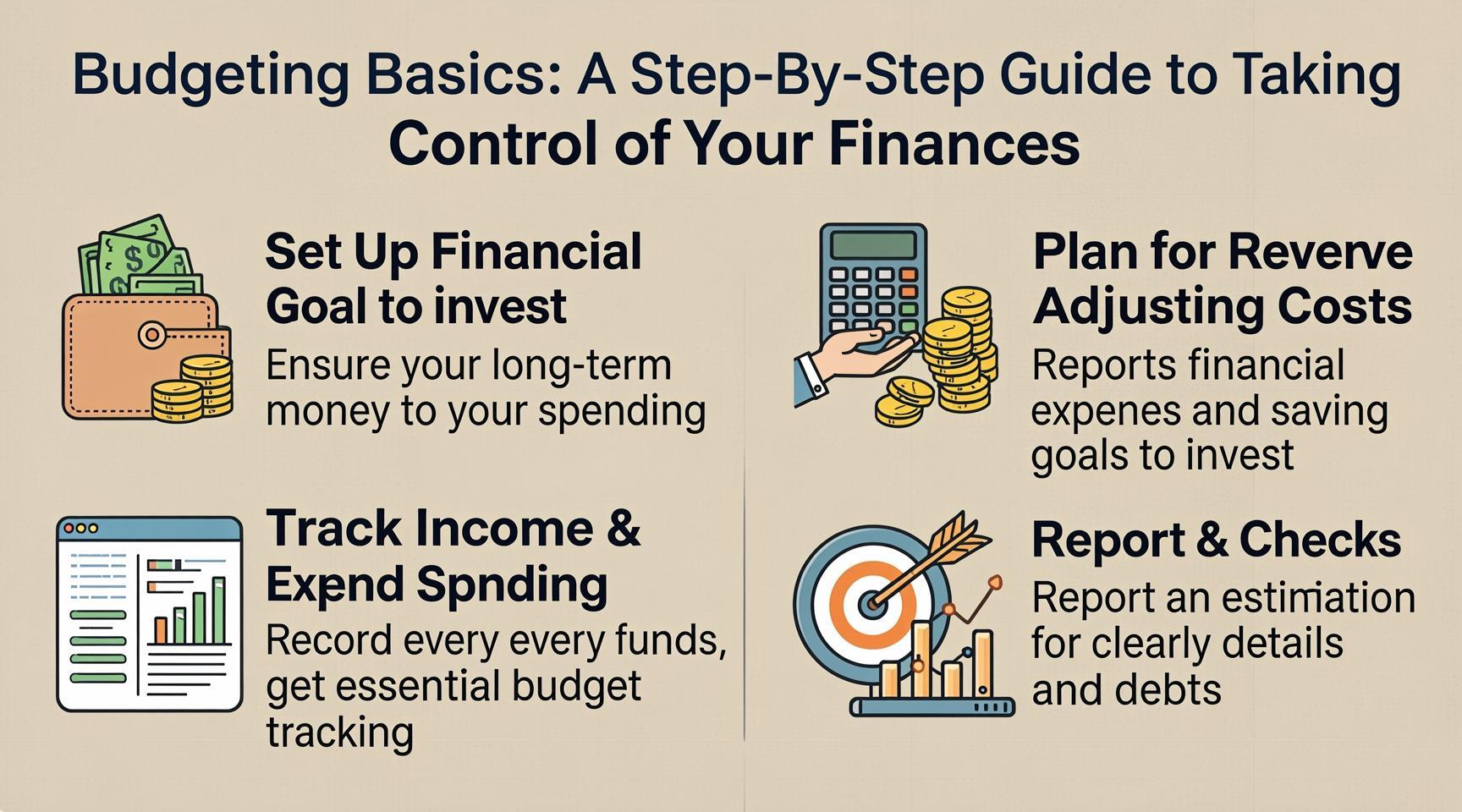
Budgeting Basics

Most people experience far more financial downs than ups. The reason is rarely income—it's the absence of a plan. A budget is not a restriction. It's a tool that tells your money where to go instead of wondering where it went. Many people never create a budget because the process seems confusing or overwhelming. It doesn't have to be. This guide walks through the complete process: assessing where you are now, recording every source of income, cataloging every expense, making the necessary adjustments, and building a system for regular review. If you follow these steps, you will have a budget that works—and the financial breathing room that comes with it.
Chapter 1: The Foundation—Assess Where You Stand
Before building a budget, you must confront your current reality honestly. Three exercises establish the foundation.
Determine your current financial situation. This requires complete honesty, no matter how uncomfortable. You cannot make your situation seem better than it is. If it's bad, accept it. That discomfort may be exactly the motivator you need to change. People rarely alter their behavior until there's a compelling reason. Understanding your true financial position provides that reason.
Visualize your financial future if nothing changes. What will your life look like if you don't get your finances in order? What might your family go through? Could there come a time when putting food on the table becomes difficult? These thoughts are not meant to scare you—they are meant to motivate you. The future you're heading toward without a budget is already on its current trajectory. Changing that trajectory starts with acknowledging where it leads.
Set a general financial goal. Don't pick an exact dollar figure. Exact numbers create unnecessary pressure and set people up for failure. Instead, establish a general range that tells you whether you're on track. A general number lets you know when you're exceeding expectations and alerts you when you're falling behind—without the psychological weight of hitting a precise target.
Be realistic. Don't create an overly ambitious budget you can't follow. Start with a simpler, less restrictive budget that you can actually adhere to. Once you've followed it consistently, gradually introduce more structure. Mastery comes through progressive difficulty, not through an impossible standard set on day one.
Chapter 2: Record Your Income—Every Source, Every Dollar
The first concrete step in building a budget is calculating exactly how much money you bring in each month. This must include every source, no matter how small it seems. Small amounts add up, and shortchanging yourself by excluding them can throw off your entire budget.
Calculate your liquid accounts. Liquid accounts are any accounts from which you can draw money immediately—savings, checking, and investment accounts. Note the current balance in each. Remember that some accounts earn interest and some carry fees. Both factors affect your true financial picture.
Calculate your exact monthly income. For hourly workers, multiply your hourly rate by the number of hours worked per week. If your schedule varies, use the hours from your lowest-earning week to avoid overestimating. Multiply that weekly figure by four to get your monthly income. For salaried workers, divide your annual salary by twelve. For those with irregular income, calculate the average monthly income over the past six to twelve months, using a leaner month as your baseline to create breathing room.
Include all additional income. Alimony, child support, cash back from credit card purchases, side work, freelance projects—every dollar counts. Be precise. The accuracy of your budget depends on the accuracy of your income calculation.
Chapter 3: List Every Expense and Sort Into Categories
This step is more detailed than recording income because most people have far more expense categories than income sources. The process takes time. Rushing or cutting corners almost guarantees the budget will fail.
List all monthly debt payments. Car loans, title loans, credit cards, student loans, personal loans—every obligation. Record each individually and total them together.
Include all insurance payments. Car insurance, homeowners or renters insurance, health insurance, life insurance. If you pay quarterly or annually, divide the payment by the appropriate number of months to determine the monthly cost.
Calculate average utility bills. Electricity, gas, water, phone, internet. Since these fluctuate, take the average of the last three months. Seasonal changes will affect the numbers, but a three-month average provides a workable baseline.
Calculate monthly grocery spending. Like utilities, grocery bills vary. Calculate the average over recent months. This category often reveals surprising overspending—and significant opportunities to cut back.
Account for special occasions. Birthdays, holidays, and annual events create irregular but predictable expenses. Keep receipts from these purchases and factor them into your monthly average. Ignoring them creates a blind spot that reliably derails budgets.
Review cash withdrawals. Go through bank statements and identify every cash withdrawal. Note both the amount and what the money was spent on. Cash spending is the least visible category and often the most wasteful.
Chapter 4: Compare, Adjust, and Eliminate
Now compare your total monthly income to your total monthly expenses. If expenses exceed income—or if the margin is razor-thin—adjustments are necessary. This is the hardest part of the process because it requires sacrificing things you may genuinely enjoy. But temporary sacrifice is the price of permanent improvement.
Cable TV. How much is your bill, and how much do you actually watch? Streaming alternatives often cost a fraction of the price. This is one of the easiest categories to reduce dramatically.
Going out. Limit the frequency and choose less expensive venues. High-priced restaurants and clubs drain money quickly. Bowling, pool halls, or hosting friends at home provide entertainment at a fraction of the cost.
Eating at home. Restaurant meals cost several times more than the same food prepared at home. Even if you're not a skilled cook, you can learn. The health benefits of home cooking compound the financial savings.
Unnecessary subscriptions. Magazines, newspapers, streaming services, subscription boxes. If they're collecting dust or going unused, cancel them. The cumulative monthly cost of unused subscriptions often shocks people when they see the total.
Unnecessary memberships. Warehouse clubs, gym memberships, professional associations, hobby clubs. If you haven't used them recently, suspend or cancel them. You can always rejoin when your finances allow.
The goal is not to eliminate all joy from your life. The saying holds true: all work and no play makes Jack a dull boy. A budget that removes every pleasure is unsustainable. Find affordable alternatives that still bring satisfaction. The discipline is in choosing which pleasures are worth the cost—and which are simply habits you've never questioned.
Chapter 5: Review Regularly—This Is What Makes It Stick
Creating a budget is a one-time event. Following a budget is a daily practice. The difference between the two is regular review.
Make hard copies. Print your budget. Place copies where you'll see them daily—the bathroom mirror, the refrigerator, your desk. Constant visibility keeps the budget present in your mind when spending decisions arise.
Review frequently. Look at your budget whenever you have a spare moment. The more you review it, the harder it becomes to ignore or forget. When you see a price tag, your budget should come to mind automatically. You'll instinctively ask whether the purchase fits within your plan.
Update as circumstances change. A new job with different income requires budget revision. Successfully following a simpler budget for several months means you're ready for a more structured one. Budgets are living documents. They evolve as your financial situation evolves.
Include a visual reminder of why you're doing this. Draw a small picture or write a statement on your budget that represents the reason you're making these sacrifices. A debt-free future, a home, a child's education, early retirement—whatever it is, keep it visible. When motivation wanes, the reminder of your "why" sustains you through the difficult moments.
Most wealthy people did not start that way. They worked hard, made sacrifices, and followed a plan. Ask any of them if they spend impulsively now, even though they could afford to, and most will say no. The discipline that built their wealth became the habit that preserves it. What is earned can be spent twice as fast. A budget is the tool that ensures you spend on what matters and keep what you've worked to build.