
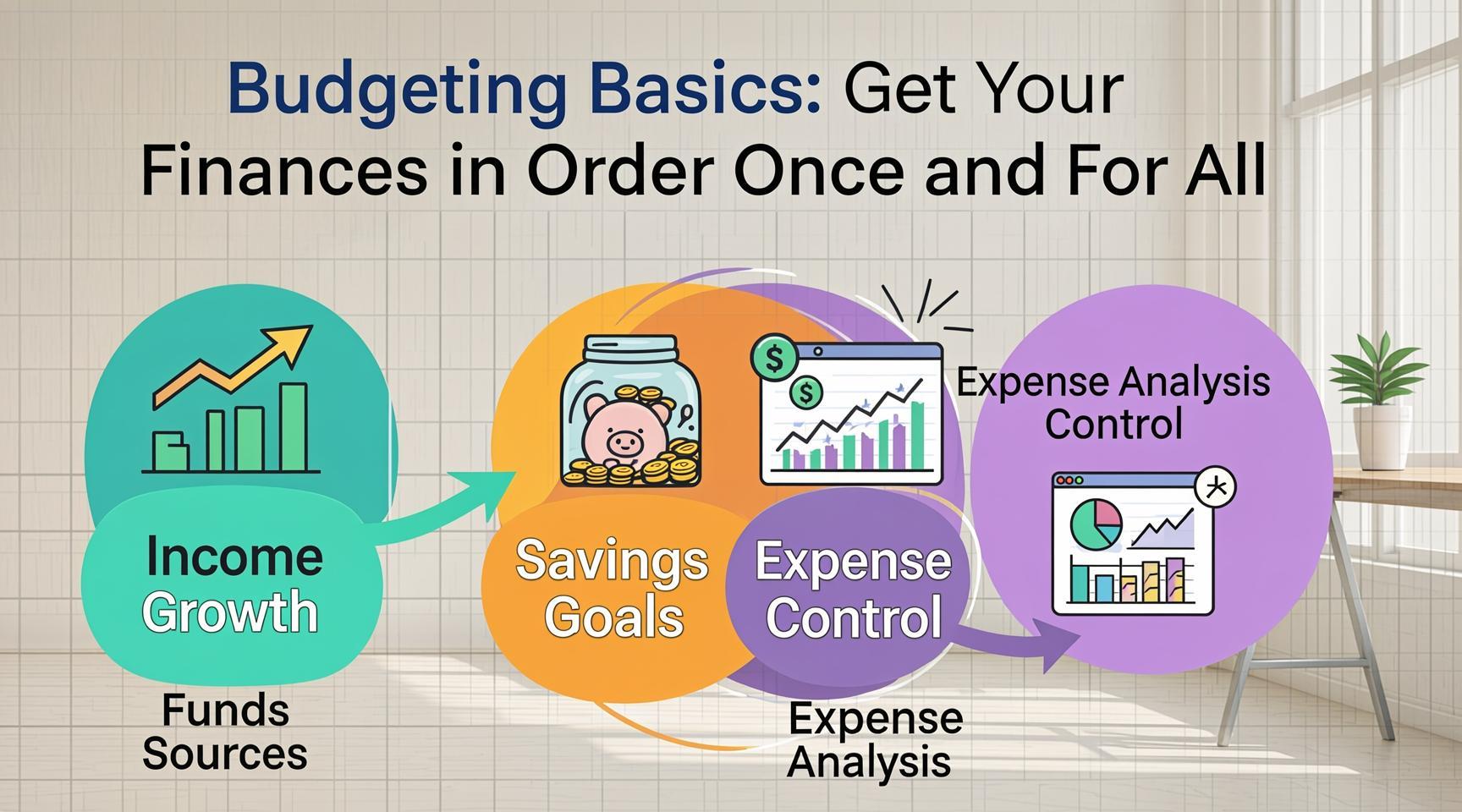
Budgeting Basics: Get Your Finances in Order Once and For All

If you are like most people, your financial situation has more downs than ups. What if your situation could be significantly better? It can be. Many people hinder their own financial success because their mentality gets in the way. They believe success isn't possible, and in doing so, they make it impossible. The mind is powerful. You must think positively while pursuing financial stability, and positive outcomes will follow. Achieving financial success is far more attainable than you likely believe. If you are determined and know what you want, you can achieve it. The first and most important step is creating a budget. This guide walks through the complete process, from understanding the fundamentals to building a system you review regularly.
Chapter 1: Budget Basics—The Foundation
Before reaching financial success, you must understand the fundamentals. The basics serve as your foundation, and a strong foundation is essential.
Determine Your Current Financial Situation
To create a budget that works, you must honestly assess where you currently stand—no matter how uncomfortable the truth may be. You cannot make your situation appear better than it is. If it's bad, accept it. Recognizing how difficult your financial position is may be exactly the motivation you need to change. People rarely alter their behavior until they have a compelling reason. Understanding your true financial state provides that reason.
Visualize Your Financial Future
Consider what your financial future will look like if you don't create a budget. Visualize what your life will become if your finances remain disorganized. Think about what your family might endure. What if, at some point, you cannot put food on the table? What if that point arrives sooner than you imagine? These visualizations may be frightening, but they can become reality. Acknowledging that possibility helps motivate the changes necessary to prevent it.
Set General Financial Goals
Set financial goals for yourself—they will help you adhere to your budget. Do not fixate on an exact dollar figure. Exact numbers create unnecessary pressure and often lead to failure. Instead, establish a general number that serves as a gauge to indicate whether you're earning enough. A general range lets you know when you're exceeding expectations and alerts you when you're falling short—without the psychological burden of a precise target.
Be Realistic
Always remain reasonable with yourself. Do not create an unrealistic budget you cannot follow. This is a guaranteed path to feeling incapable of budgeting at all. You may need to create different budgets over time. Start with a simpler budget that's easier to follow. Once you've maintained it without setbacks, progress to more structured and detailed budgets. Before long, budgeting will feel natural, and the benefits will flow into your life.
Chapter 2: Record Your Income—Every Dollar Counts
Figuring out your exact income can be challenging, especially if you struggle with numbers or have multiple income sources. Do not feel overwhelmed. With proper guidance, financial progress is closer than you think.
Calculate Liquid Account Balances
Liquid accounts are any accounts from which you can draw money immediately—savings, checking, and investment accounts. Note the current balance in each. Remember that some accounts earn interest and some carry fees. Both factors must be included in your calculations.
Determine Your Exact Monthly Income
For hourly workers: Multiply your hourly rate by the number of hours worked each week. If your schedule varies, use the hours from your lowest-earning week rather than your highest to prevent falling short later. Multiply that weekly figure by four to determine your monthly income.
For salaried workers: Divide your annual salary by twelve. Monthly budgets are far easier to create and maintain than annual ones.
For irregular income: Calculate your average monthly income over the past six to twelve months. Use a leaner month as your baseline to create breathing room in your budget.
Include all additional income. Alimony, child support, cash back from credit cards—every dollar, no matter how small. Small amounts accumulate, and excluding them distorts your budget.
Chapter 3: List Every Expense and Sort Into Categories
Just as with income, you must include all expenses—no matter how insignificant they seem. Small expenses accumulate and can overwhelm your budget if unaccounted for. This step may be more complex than listing income because most people have far more expense categories than income sources. Precision and patience are essential. Rushing or cutting corners almost guarantees budget failure.
Calculate Monthly Debt Obligations
List everything: car loans, title loans, credit cards, student loans, personal loans, and any other debt. Total them. This is essential for climbing out of financial difficulty.
Include All Insurance Payments
Car insurance, homeowners or renters insurance, health coverage. If you pay quarterly or annually, divide by the appropriate number of months to determine the monthly cost.
Average Your Utility Bills
Electricity, gas, water, phone. Utility bills vary month to month, especially with seasonal changes. Calculate the average of the last three months for each.
Calculate Average Grocery Spending
Like utilities, grocery costs fluctuate. Calculate the average of recent months. You may discover you need to switch to less expensive brands or reduce certain purchases.
Account for Special Occasions
Birthdays, holidays, and annual events create irregular but predictable expenses. Keep receipts from these purchases so you can include them accurately in your expense list.
Review Cash Withdrawals
Examine bank statements and identify every cash withdrawal. Record both the amount and what the money purchased. Cash spending is often the least visible category and the most wasteful.
Chapter 4: Total Everything and Make Adjustments
Now compare your total monthly income to your total monthly expenses. If you're spending more than you earn—or if the margin is razor-thin—changes are necessary. If expenses exceed income, you're in a dangerous position. It can feel like being trapped in a black hole with no escape, the weight of debt pulling you deeper until you can no longer see a way out.
Achieving financial success requires giving up certain things, at least temporarily. Almost everyone who built wealth from nothing made significant sacrifices. You must distinguish between what is essential and what is merely desired. Knowing the difference enables difficult financial decisions.
Cable TV. Is it genuinely necessary? What does it cost, and how much do you actually watch?
Going out. Limit frequency and choose less expensive venues. High-priced clubs and restaurants empty your wallet for food that's often overrated. Bowling, pool halls, or hosting friends at home provide entertainment at a fraction of the cost.
Eating at home. Restaurant meals cost several times more than the same food prepared at home. Even if you're not a skilled cook, you can learn. The health benefits compound the financial savings.
Unnecessary subscriptions. Magazines, newspapers, streaming services—if they're collecting dust, cancel them. The money can fund far more valuable priorities.
Unnecessary memberships. Warehouse clubs you never visit, car clubs, professional associations you don't use—suspend or cancel them until your finances improve.
Nobody claimed every step of budgeting would be easy, but it will benefit your life in the long run. Still, find ways to preserve some joy. The saying holds true: all work and no play makes Jack a dull boy. A budget that eliminates every pleasure is unsustainable. The goal is intentional spending, not total deprivation.
Chapter 5: Review Regularly—The Habit That Makes Budgeting Stick
Once your budget is complete, make hard copies. Place them where you'll see them daily—the bathroom mirror, the refrigerator, your desk. Constant visibility keeps the budget present in your mind when spending decisions arise.
Regular review makes forgetting your budget nearly impossible. When you see a price tag, your budget should come to mind automatically. You'll instinctively understand that purchasing this item means reducing spending elsewhere. Whether the tradeoff is worthwhile becomes your conscious choice.
Review also reveals when your budget needs revision. As mentioned, you'll likely start with a simpler budget and progress to more structured versions. Without regular review, you won't recognize when you're ready to advance. A new job with different income requires budget adjustments. Budgets are living documents that evolve as your financial life evolves.
Consider adding a visual reminder to your budget—a small drawing or a written statement describing why you're doing this. When motivation wanes, that reminder of your "why" keeps the benefits of your discipline at the forefront of your mind. Much of this process depends on determination and hard work. Without both, you will not progress.
Wrapping Up
Creating and following a budget is genuinely difficult, but it is absolutely possible if you remain committed. Always keep the benefits of your discipline in mind. This will sustain your motivation and keep you fighting for financial security.
If you struggle initially, do not be discouraged. Most people find budgeting extremely difficult at the beginning, but it becomes easier over time as wallets grow heavier. Achieving financial success requires giving up many things, but those sacrifices are replaced by a secure future and wealth beyond what you imagined possible.
Most wealthy people did not start that way. They worked hard and made sacrifices like everyone else. Ask any of them if they spend impulsively now, even though they could afford to—most will say no. The discipline that built their wealth became the habit that preserves it. They understand that what is earned can be spent twice as fast.
If you follow your budget, you will soon see results. Your life will improve. Your stress will decrease. You will once again enjoy the smaller pleasures of life without constantly worrying about bills and expenses. It will be difficult, but you can accomplish it. The only remaining step is to begin.