
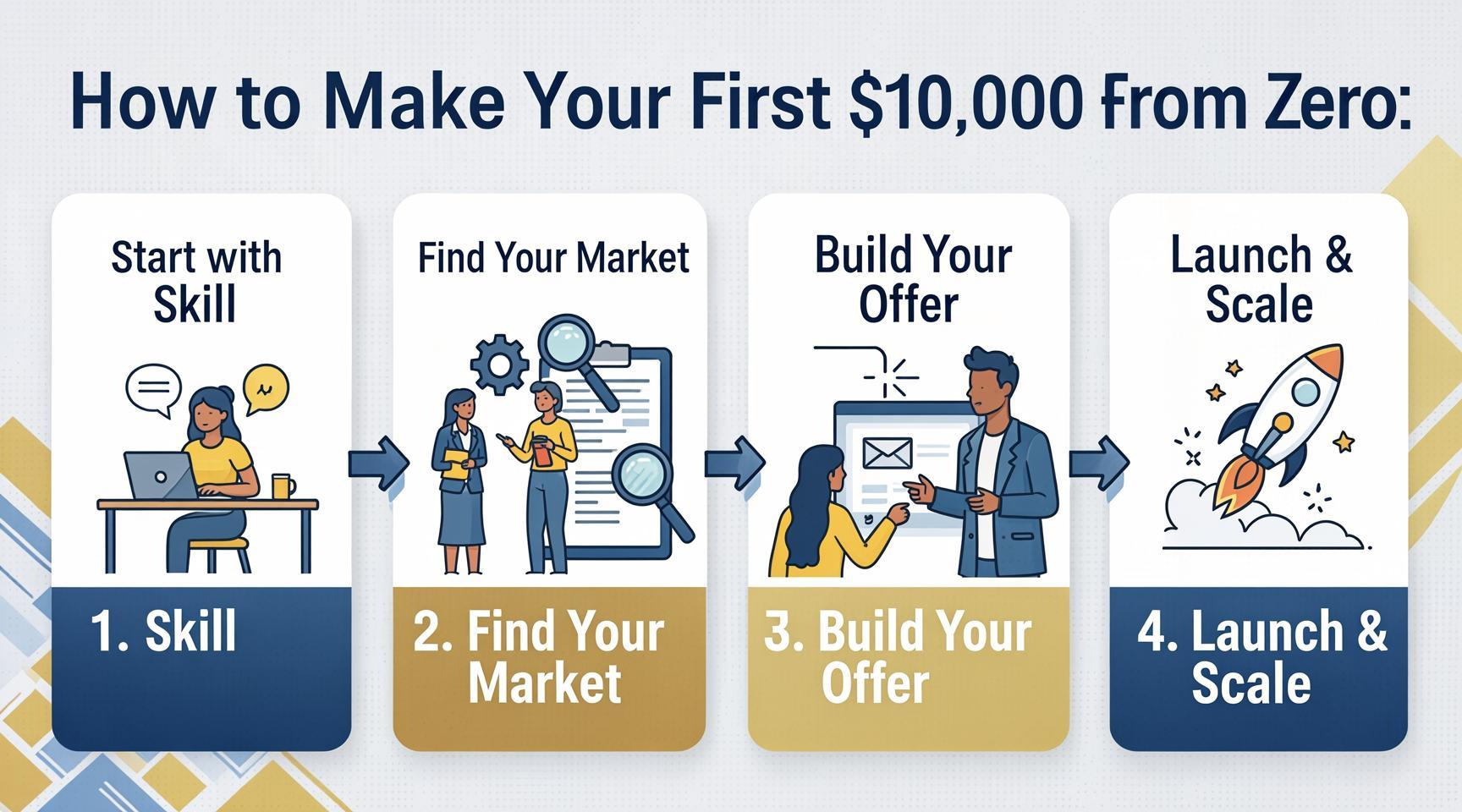
How to Make Your First $10,000 From Zero

Most people make the process of earning money far harder than it needs to be. They chase crypto because a friend profited, or dive into day trading because a guru promised riches. Both require substantial upfront capital and extraordinary luck—they are tools to multiply existing money, not methods to create it from nothing. When you're starting from zero, you need something that requires minimal upfront investment and puts cash in your pocket consistently. After building personal wealth from nothing, the pattern is clear: the first $10,000 is the hardest to make, but once you hit it, everything changes. It proves that making money is a skill, not luck. Once you've done it once, you can do it again and again, scaling it into real wealth. Here is the exact three-step formula to make your first $10,000 starting from zero.
Step 1: Choose the Right Money-Making Vehicle
When you strip away the noise, there are only four real options for generating income from scratch. The choice you make here is crucial because different options offer different levels of scalability, speed, and earning potential.
Option 1: In-Person Services
Personal training, delivery driving, dog walking, nail design, barbering, videography, car washing—these are the fastest ways to start making money immediately. They require little more than some skills and basic tools. Don't waste time building a website, running ads, or designing a logo. Find customers in your local area, deliver the service, and get paid.
This was the starting point: walking around wealthy neighborhoods offering to wash cars, specifically targeting homes with immaculate gardens but dirty vehicles. The logic was simple—if someone obsesses over their garden, they'll want a pristine car in the driveway.
The limitation is geography and time. Demand fluctuates. You can only serve one client at a time. In-person services are excellent for generating quick cash but quickly feel limiting.
Option 2: Local Products
Selling home-baked goods, handmade items, artwork, or fresh produce turns a skill or hobby into income. Unlike services where payment is immediate, product sales take time to build. The margins can be thin—material costs eat into profits, and the customer base is limited to those nearby who will pay your required price. It's rewarding if you love what you make, but scaling is difficult.
Option 3: Global Products
Clothing brands, dropshipping, sneaker reselling, and print-on-demand give access to a worldwide customer base. The trade-off is that profits must be continuously reinvested into inventory. Sell ten items, buy twenty more. Money gets trapped in a restocking cycle. It takes one to three months to gain traction, but once operational, it becomes one of the most passive income streams available.
Option 4: Online Services
Copywriting, video editing, thumbnail design, ad management, social media management—these combine the global reach of products with the high profit margins of services. Products typically yield 20–30% margins that require reinvestment. Services produce 70–80% margins that go directly into your pocket, and you can start earning from day one.
For the fastest path to $10,000, online services are the optimal choice.
Step 2: Master the Skill Pyramid
Making $10,000 from an online service requires mastering four interconnected elements. Missing even one keeps you stuck working hard without breaking through.
Element 1: Positioning
Not all online services are equally profitable. The real money lies in helping businesses make more money. Businesses think about money differently than individuals. A business earning $50,000 monthly doesn't hesitate to spend $2,000 solving a problem if it increases revenue. They perpetually need more customers, better systems, competitive differentiation, and higher conversion rates. These problems never disappear, and businesses always pay to solve them.
Some industries simply have more money than others. Reposition yourself where the money flows: instead of editing videos for small YouTubers, edit for entrepreneurs who sell products. Instead of making random thumbnails, become the primary designer for an established creator. Instead of writing cheap articles, optimize landing pages that generate sales. This isn't about learning more skills—it's about placing yourself where money is already being spent.
Element 2: Leverage
You'll never reach $10,000 without leveraging value over time. Businesses don't pay for effort; they pay for results. Stop charging for hours worked and start charging for the return on investment you provide.
If you run Facebook ads, charging per hour locks you into a fixed rate where the client always wants fewer hours. Charging based on the revenue you generate shifts the conversation entirely—they stop thinking about cost and start thinking about profit. When they see your work directly increasing their income, they happily pay more.
The same applies to social media management. Scheduling posts and replying to comments makes you replaceable. Proving your strategy drives engagement, leads, and sales makes you a valuable asset. Shift your pitch from what you do to what they gain, and people become willing to pay substantially more.
Element 3: Reach
The biggest mistake beginners make is thinking they must constantly chase clients. From day one, build systems that make clients come to you.
Post your work publicly. If you edit videos, share before-and-after comparisons. If you design thumbnails, explain why your design generated more clicks. If you're learning social media growth, document your process of building an account from zero. The opportunities that come from simply putting your work in front of people are unpredictable and often significant.
A real example: a graphic designer posted movie-style poster designs on TikTok purely for fun, with no intention of monetizing. His videos gained traction. His inbox filled with inquiries. He reached back out weeks later asking how to start charging, and now works consistently for multiple paying clients. He never chased a single one—the content brought them to him.
Element 4: Automation and Reliability
After working with countless freelancers, the pattern is unmistakable: 95% of people who attempt a side hustle fail because they miss deadlines. The trait that makes you stand out isn't talent or charisma—it's reliability. The people who end up earning thousands consistently aren't always the most skilled. They are the most organized. They never miss deadlines. They communicate clearly. They make working with them effortless.
Use a CRM system to track who you've spoken with, what they need, and your next actions. Visualize opportunities at each stage so you know where to focus. Schedule calls and meetings without friction. Keep emails, notes, and files in one place. Set reminders for follow-ups. At the end of the day, clients don't just want someone skilled—they want someone they can count on. Being good gets you hired once. Being reliable gets you paid repeatedly.
Step 3: Turn Income Into Wealth
Making money is the first battle. Keeping it and growing it is the second. Until you've accumulated significant savings, lifestyle inflation is the enemy. The supercars, designer clothes, and nights out mean nothing if you can't convert income into lasting wealth. The rich spend their income. The wealthy use it to create more.
Investment 1: High-Interest Savings Account
This isn't about making big returns—it's about having a financial buffer. When the market crashes and an emergency strikes, cash on hand prevents being forced to sell investments at a loss. A savings account is a safety net, not a wealth-building tool. It ensures unexpected expenses don't destroy long-term positions.
Investment 2: Index Funds
The S&P 500—tracking 500 of the largest publicly traded U.S. companies—has delivered average annual returns exceeding 10% over the last decade. Investing $5 daily instead of buying a coffee, from age 18 to 67, at that rate yields over $1 million at retirement. Total stock market funds and emerging market funds add diversification. Index fund investing is low-maintenance, historically reliable, and accessible with small amounts of capital.
Investment 3: Individual Stocks
Individual stocks offer hands-on engagement that index funds don't provide. Picking companies and learning to read financial statements builds market literacy that passive investing never teaches. They carry higher risk, especially with smaller amounts, but the direct exposure to specific companies and the experience of managing volatility is educational. The key is starting small and treating it as a learning process alongside broader index fund positions.
Investment 4: Cryptocurrency
Bitcoin and Ethereum, approached with dollar-cost averaging and a long-term perspective, have proven to be significant wealth generators for patient investors. Altcoins and meme coins can produce wild returns but carry proportionally higher risk—for every fortune made, many are lost just as quickly. Build positions slowly. Only invest what you can afford to lose. Do your own research. Crypto is volatile, and unlike traditional assets, carries unique risks.