Meta's Massive AI Update

Meta has finally released a significant AI model update that demands attention. This isn't an incremental improvement—it's a fundamental upgrade that brings capabilities previously unseen in Meta's AI offerings. Given Meta's ownership of Facebook, WhatsApp, Instagram, and its access to billions of users and their data, expectations for its AI capabilities have always been high. The company has been late to the advanced AI race compared to Google, OpenAI, and Anthropic. But this update suggests Meta has finally found the right track. Here's a complete breakdown of what's new, how it performs against competitors, and what the multi-agent capabilities actually look like in practice.
Performance Leap: From Single Digits to Competitive With Giants
The benchmark improvements compared to the previous model are dramatic. On coding benchmarks like CodeBas, the previous model scored 24. The new model scores 42—nearly doubling performance. On the JobBench evaluation, it jumped from 17 to 54. On the VibeCode benchmark, it moved from 19.7 to 72.2—not a doubling or tripling, but a nearly fourfold increase. These are not marginal gains. They represent a model that has moved from "not competitive" to "in the conversation with the frontier models."
When compared against the current industry leaders—Gemini 3.1 Pro, Claude Opus 4.8, and GPT-5—the gap has narrowed significantly. Meta's model is now close to the giants. The benchmark charts show a model that belongs in the same tier, even if it doesn't lead every category.
Multi-Agent Architecture: The Core Innovation
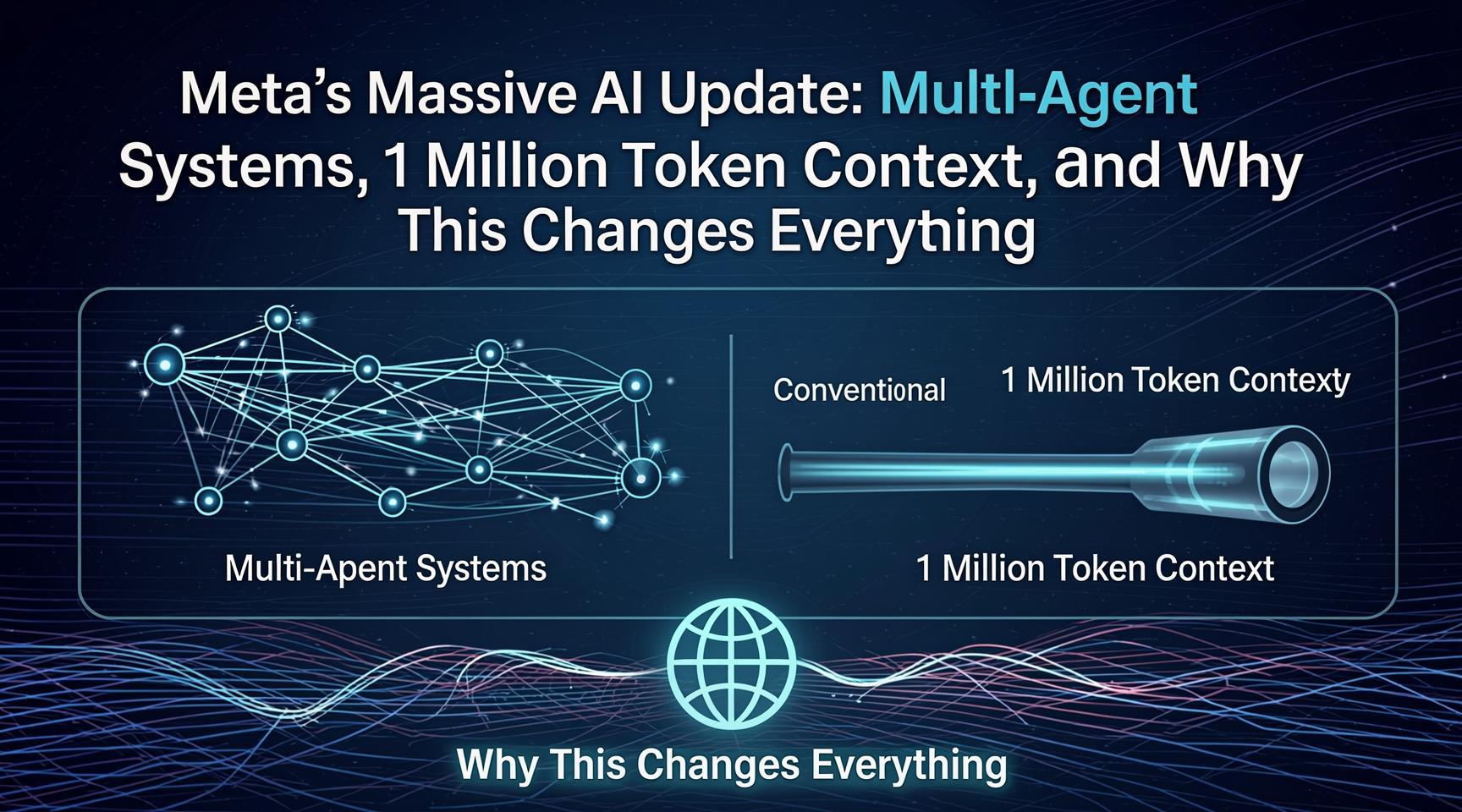
The most significant technical advancement is the multi-agent system. The model operates as a coordinating agent that first gathers context, then formulates a plan, and finally delegates tasks to sub-agents that work in parallel. This dramatically reduces execution time compared to sequential processing.
A practical demonstration shows the capability. In a standard chat interface, the AI agent is invoked. It opens a new browser tab, navigates to a company's official website, extracts the Instagram contact information, opens Instagram, and sends a message to the company through the existing messenger conversation thread. It can even send messages to all competitors or all branches across different states. This is autonomous agent behavior—the AI acts as your delegate, your proxy, executing multi-step real-world tasks without step-by-step human guidance.
1 Million Token Context Window With Memory Compression
The model manages a context window of up to 1 million tokens with high efficiency. More importantly, it remembers previous actions. It retrieves old information and, critically, compresses data to retain only the decisive steps. This compression capability is something not commonly seen in other models, and it plays to Meta's established expertise in data compression technologies. The model can adapt automatically to unexpected changes—for example, adjusting plans during event organization without requiring user intervention.
Autonomous Computer Use
The model navigates between unfamiliar interfaces and applications and adapts to changing requirements. Instead of clicking step by step through a user interface, it can inject scripts directly into the browser—a technique familiar to developers as working through the console—to execute actions more efficiently. For simpler interactions, direct clicking is used. The model intelligently batches actions to save time, generating action packages in each step.
Coding and Development Improvements
The coding capabilities have been substantially upgraded. The model was trained on real-world examples, real scenarios, and real codebases. Programming is fundamentally about applying code patterns, and training on authentic development scenarios rather than synthetic examples produces measurably better results. Meta's internal coding benchmarks show significant superiority over the previous version.
Multimodal Perception
The model demonstrates integrated multimodal perception—excelling at vision, reasoning, and tool use simultaneously. It can convert visual elements into code and provide extremely precise descriptions of images and video. This capability exists across all major competitors including Claude, so it's not unique, but it's now competitive.
How to Access the New Model
The new model is available through Meta's AI platform. To activate it, enable the Thinking Mode toggle in the interface. This switches from the classic model to version 1.1. The interface also shows several new additions: an image generator, a section called "Vibes" that appears to be a gallery of AI-generated images and videos created by users across Facebook, WhatsApp, and Instagram, a Media section, and a Search function. These features are accessible for exploration.
For developers, Meta has released an API version specifically for integrating the AI into applications and websites.