
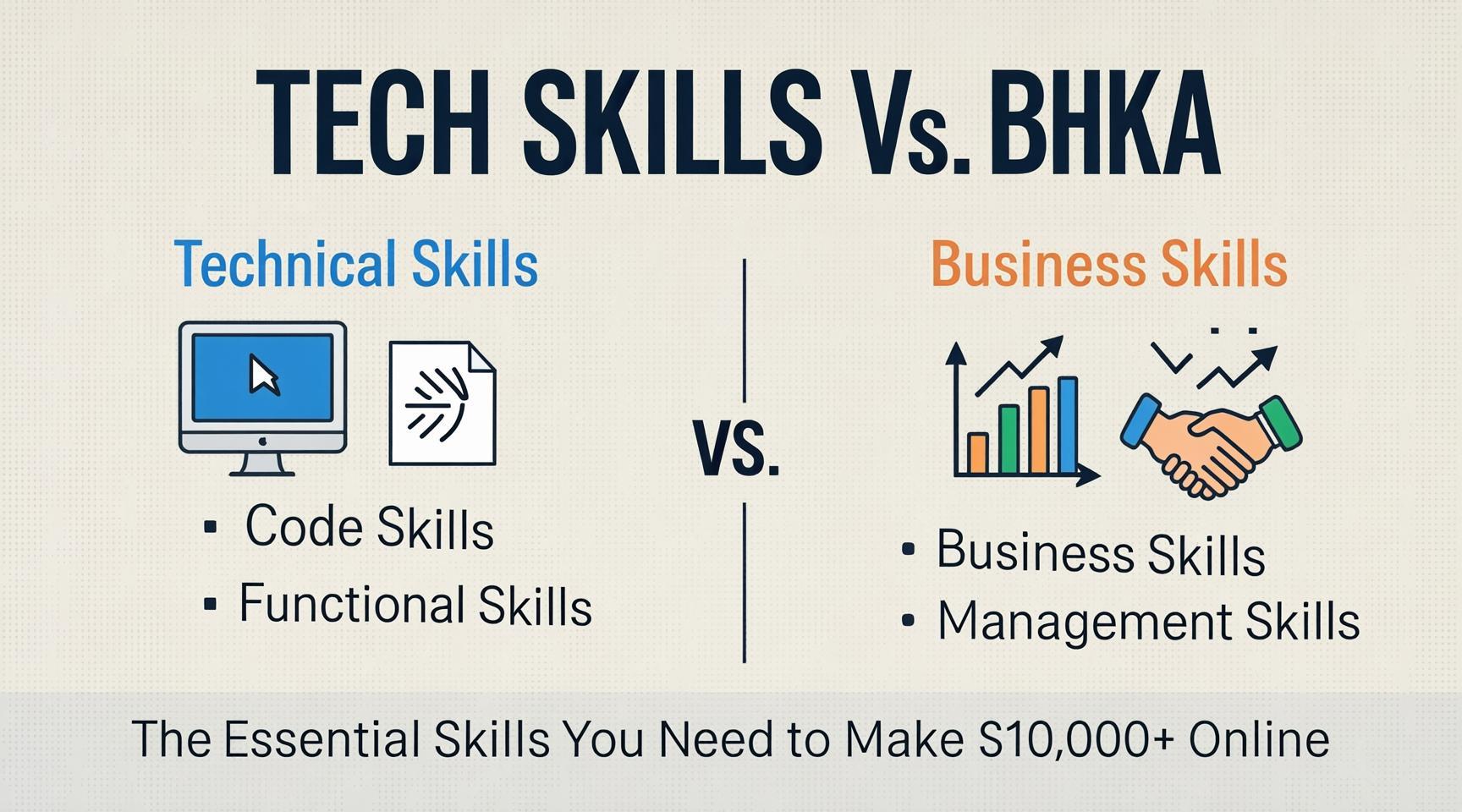
The Essential Skills You Need to Make $10,000+ Online

Many beginners believe there's a secret domain, a magic project, or a hidden method that generates money online quickly. After years in the business, the reality is different: the money you make is a direct reflection of the skills you've accumulated. There is no shortcut. But there is a clear path. The skills that generate income fall into two categories—technical skills and business skills (often called soft skills). Technical skills get you started and give you something valuable to offer. Business skills are what allow you to convert those technical abilities into revenue, scale beyond yourself, and build something sustainable. Most people who fail have strong technical skills but completely neglected the second category. Here is the complete breakdown of both, why each matters, and the specific order in which you should develop them.
Part 1: The Three Technical Skills That Get You Started
Technical skills are the entry point. They give you a marketable capability—something you can do that someone else will pay for. When you're starting from zero, confused about which direction to take, and jumping from one domain to another without progress, these three skills provide a foundation.
Skill 1: Copywriting
Copywriting is the skill of converting an offer or a product into written words that sell. It encompasses landing page copy, ad creatives, video sales letters, webinar scripts, email sequences, and more. This is arguably the single most valuable technical skill for anyone in online business because every transaction requires persuasion, and persuasion happens through words.
The objection is predictable: AI can write copy. AI can produce decent copy in English. In Arabic, AI-generated copy still falls short of professional quality. Even in English, AI output requires substantial editing and restructuring to sound human and sell effectively. AI gives you a starting point. It does not give you a finished, high-converting piece of sales copy. Understanding how to structure a message, how to address objections, how to build desire, and how to close—these are human skills that AI assists but does not replace.
The businesses that need this skill most are those already selling. Companies and entrepreneurs who have products understand that better copy directly increases revenue. They pay premium rates for it. Copywriting is the complement to any offer—it's the mechanism through which attention becomes action.
Skill 2: Content Creation
Content creation is the ability to speak to a camera, explain a topic, and build an audience. This skill extends far beyond social media. It improves your sales calls, your webinars, your presentations, and your ability to communicate with clients. Being able to articulate ideas clearly on video is a multiplier on every other skill you develop.
Most people avoid this skill entirely. They're camera-shy. They're self-conscious. They're afraid of judgment. This is normal. The solution is volume. The first videos will be uncomfortable. After dozens, the discomfort fades. After hundreds, it becomes natural. After thousands, you forget you were ever afraid.
Content creation requires patience. The first year may produce almost no visible results. Accounts with six years of consistent posting started with twenty subscribers and zero engagement. The people who succeed are the ones who persist through the invisible period when nobody is watching. The ones who quit are the ones who expected immediate results.
The payoff is asymmetric. A personal brand built through consistent content brings clients to you instead of you chasing them. Opportunities arrive that never would have existed otherwise. The skill of communicating on camera compounds over time in ways that are impossible to predict at the start.
Skill 3: Funnels
A funnel is the structured path that converts a stranger into a buyer. It's the sequence someone follows from first seeing your ad or content, to landing on your page, to reading your offer, to filling out a form or making a purchase. Understanding how to build that sequence—how to structure each step, what to say at each stage, how to handle objections, how to maximize conversion—is a technical skill that virtually every business needs.
At the simplest level, a funnel is: someone sees your content or ad, clicks through to a landing page, reads the headline, scrolls through the page, reaches the call to action, and either buys or opts in. Every element in that chain affects conversion. Understanding the psychology of each step and how to optimize it is what separates funnels that convert from funnels that don't.
Companies that sell products or services all need this skill. They need someone who can increase their conversion rate, who can turn more visitors into buyers. This skill commands high prices because it directly impacts revenue.
Part 2: The Three Business Skills That Allow You to Scale
Technical skills alone are not enough. This is the lesson that takes most people years to learn. You can be excellent at copywriting, content creation, or funnel building and still make no money. The missing piece is the ability to convert technical skill into revenue—and that requires a completely different set of abilities.
Skill 1: Sales
Sales is not the same as copywriting. Copywriting is writing words that persuade at scale. Sales is the direct, human-to-human process of understanding psychology, reading emotions, building trust, asking the right questions, handling objections, and closing. It requires emotional intelligence, self-awareness, and the ability to manage relationships in real time.
Sales involves understanding how people make decisions, what motivates them, what they fear, and what they trust. It involves knowing when to push and when to listen. It involves handling rejection without internalizing it. These are life skills, not technical skills. They are learned through practice, through real conversations, through making mistakes in front of real people.
If you cannot sell, you cannot convert any technical skill into income at scale. You may get lucky with a few clients through referrals or content, but you will never have consistent, predictable revenue without the ability to sell directly.
Skill 2: Communication
Communication is distinct from content creation. Content creation is broadcasting. Communication is the ability to express your ideas, emotions, and intentions clearly and to understand those of others. It affects every relationship in business—with clients, with team members, with partners, with anyone you interact with.
Poor communication limits everything. You can have the best strategy in the world, but if you cannot articulate it to your team, it never gets executed. You can have the best offer, but if you cannot express its value to a potential client, they never buy. Communication is the infrastructure on which all other business activities run.
This skill develops through interaction. The more people you talk to, the more situations you navigate, the more conflicts you resolve, the stronger your communication becomes. There is no shortcut. It's a function of volume and attention.
Skill 3: Systems
At a certain point, you stop doing the technical work yourself. You hire people. You build a team. You delegate. The challenge shifts from "how do I do this task" to "how do I build a process that someone else can follow to produce the same result consistently."
Systems are the answer. There are two types. Operating systems are the documented processes for how specific tasks get done—the step-by-step instructions that allow anyone on the team to execute without asking you. Standards are the documented expectations and quality benchmarks that every output must meet.
Building systems is boring. It's repetitive. It's the opposite of the exciting creative work that attracted most people to online business in the first place. But scaling is boring. Revenue at high levels comes from doing the same thing consistently, not from doing something new every day. The businesses that grow are the ones that systematize everything. The businesses that stagnate are the ones where everything depends on the founder personally doing the work.
The Relationship Between the Two Categories
Technical skills open the door. They give you something to offer. They allow you to start. Business skills are what allow you to grow. Without technical skills, you have nothing to sell. Without business skills, you can never sell enough to scale beyond yourself.
The sequence matters. Start with one technical skill. Master it to a level where you can deliver real value. Then layer on the business skills—learn to sell what you can do, learn to communicate effectively with clients and team members, learn to build systems that allow others to execute. The combination is what produces income that grows year after year rather than capping out at whatever you can personally produce.